
Choosing the right e-learning platform Australia
The four things that matter when comparing Australian digital learning platforms: usability, content quality, reporting and personalised learning...

8 min read
Mathan Allington
Updated on September 30, 2026
An enterprise learning platform is the central system a large organisation uses to plan, deliver, track and prove workforce development, across every team, site and employment type it runs. At enterprise scale the job is bigger than hosting courses: the platform has to schedule instructor-led training, hold audit-ready records, map capability against the work, and report all of it to people who will never log in to browse a catalogue. This guide covers what the category includes, how it differs from an LMS, an LXP and a training operations platform, and what to test before you sign anything.
Last reviewed September 2026.
Four jobs sit underneath the category, and most buying mistakes come from assuming a vendor does all four when they do one or two well.
Most organisations start at delivery, discover the second and third jobs about six months in, and reach the fourth only when an executive asks what the training budget bought. Buying for all four at the start costs less than buying twice.
Scale changes the requirements more than the feature list suggests. With three hundred people you can fix a broken enrolment by walking over to someone's desk. With eight thousand across four countries, permissions, hierarchy, data residency, single sign-on and reporting by business unit stop being nice-to-haves. So does the ability for a site manager to see their own team's compliance status without raising a ticket with a central team.
The naming in this market is loose, and vendors often describe themselves using whichever label is selling that year. The distinctions below are the practical ones: what each type of system is built to be good at, and where each tends to disappoint.
| Type of platform | Built to do | Where it usually falls short | Best fit |
|---|---|---|---|
| Learning management system (LMS) | Deliver structured courses, track completions, hold compliance records and report on them. | Discovery and engagement. Catalogues can go stale, and completion data says little about capability. | Organisations with mandatory training, defined curricula and audit obligations. |
| Learning experience platform (LXP) | Surface content people want, recommend it, and pull in third-party libraries and user-generated material. | Compliance rigour and operations. Weaker on scheduling, evidence and reporting that stands up to an audit. | Knowledge workforces where the constraint is motivation rather than mandate. |
| Training operations platform | Run the logistics: sessions, trainers, venues, equipment, external providers, costs, renewals and rosters. | Content and capability. Often assumes the learning itself lives somewhere else. | Field, clinical, industrial and regulated workforces with heavy instructor-led delivery. |
| Capability or skills platform | Map skills against roles and work, identify gaps, and target development where it changes something. | Delivery. Usually needs a content system alongside it to do the teaching. | Workforce planning, succession and upskilling decisions across large teams. |
An enterprise learning platform, properly specified, covers the first three columns of work and connects to the fourth. Where a vendor covers only one, the cost of the other two arrives later as integration work, a second subscription, or an administrator quietly rebuilding it in a spreadsheet. If you also need to know what belongs in your HR system rather than your learning system, our comparison of an LMS and an HRIS draws that line.
Training operations is the half of enterprise learning that rarely appears in a demo, because it is unglamorous and it is where the work actually is. If a meaningful share of your training happens in a room, a yard, a ward or a vehicle, this is the part that decides whether the platform survives contact with your organisation.
The operational load usually includes scheduled sessions with capacity limits and waitlists, trainer assignment and availability, venues and equipment, travel and cost tracking, external provider bookings, and cancellations that have to cascade to everyone affected. Add renewals: tickets, licences and certifications that expire on different cycles for different people, each needing a reminder early enough for the person to actually do something about it.
Then there is the reporting. A site manager wants to know who is cleared to work on Monday. A compliance manager wants the evidence pack for an audit next month. A finance business partner wants what training cost by cost centre. These are three different questions from three different people, and a platform that answers them only by exporting a spreadsheet for someone to pivot is adding a job rather than removing one.
Two questions separate serious contenders during evaluation. Can a frontline supervisor see and fix their own team's status without a central administrator? And when someone fails to attend a mandatory session, what happens automatically? If the honest answer to the second is "nothing, until someone notices", the operational gap will still be yours after implementation.
Vendor feature lists converge, so evaluate against what will actually break. These are the areas where enterprise deployments most often come unstuck.
Run the evaluation against a written requirements document rather than a shortlist of vendors. An LMS request for proposal template gives you the structure, and the discipline of writing requirements first tends to remove one or two vendors from your list before you have sat through their pitch.
Upskilling is a different buying problem from compliance, and the same platform has to serve both. Compliance asks whether everyone completed the mandatory item. Upskilling asks whether the organisation will have the capabilities it needs in eighteen months, which no completion report can answer.
Start from the work rather than the catalogue. Define the capabilities each role group requires, at what level, then measure where people actually sit. A skills matrix is the simplest version of this and it exposes concentration risk quickly: the two people who can do a critical task, the shift with no qualified backup, the team whose depth disappears with one resignation.
From there, targeted development beats a bigger library. Buying access to twenty thousand courses feels generous and usually produces low single-digit engagement, because the constraint was never supply. Assigning four people a specific pathway tied to work they are about to do produces completion rates that make the investment obvious.
Three practical tests for an upskilling platform at enterprise scale: can it describe capability at a level of detail your managers recognise, can it show movement in that capability over time, and can a manager see their team's position without asking anyone. Platforms that pass all three tend to get used by managers, and manager use is the single best predictor of whether learning sticks.
Plenty of the search demand for enterprise learning comes from people running development for a few hundred staff rather than a few thousand. The requirements overlap, but the priorities shift.
Administration effort matters more, because there is rarely a dedicated learning administrator. Anything that needs a specialist to configure will not get configured. Time to value matters more too: a six-month implementation is unaffordable when the person driving it also owns recruitment and remuneration.
What stays the same is the record keeping. A two-hundred-person organisation in a regulated industry carries the same evidence obligation as a two-thousand-person one, and a shared drive of completion certificates is a problem waiting for an audit. Buy for the obligation you have, not the headcount you have.
Most learning reporting measures activity: logins, completions, hours consumed. Activity is easy to count and it convinces nobody holding a budget.
The measures that travel are the ones already on someone else's report. Time to productivity for new starters, before and after a structured onboarding pathway. Rework, defects or safety incidents in the teams that completed a specific program, compared with teams that have not yet. Internal fill rate for roles you used to hire externally. Overtime spent covering work that only a small number of people were qualified to do. Each of these connects development to a number a finance team already tracks, which is what turns a renewal conversation from a negotiation into a formality.
Build the baseline before you start rather than reconstructing it afterwards. Our training ROI calculator sets out the inputs worth capturing first, and the exercise of filling it in usually reveals which measures you cannot currently produce, which is useful information on its own.
Enterprise learning design tends to assume that everyone absorbs and applies information the same way, and the completion data usually says otherwise. How people prefer to work shapes how they engage with development: some want the reasoning and the evidence before they will act, others want to try it and correct as they go.
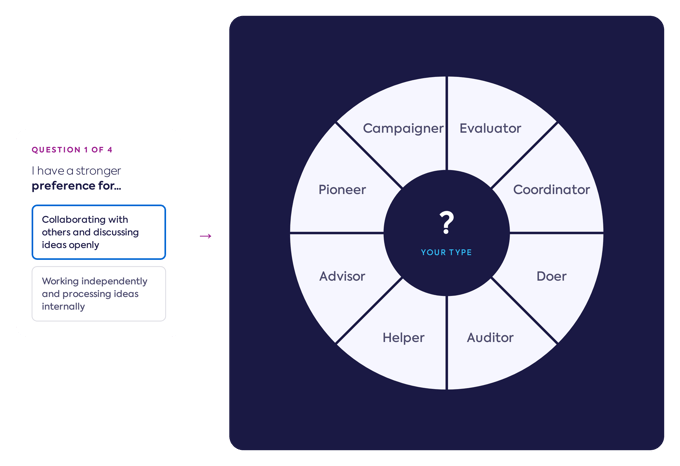
Compono describes eight work personalities: Doer, Auditor, Helper, Advisor, Pioneer, Campaigner, Evaluator and Coordinator. A Pioneer given a rigid, linear module tends to disengage, while an Auditor given a loose, discovery-based exercise wants the specification and the correct answer. Neither preference is a deficiency, and neither is visible in a completion percentage.
The practical move is not to build eight versions of everything. It is to vary the format across a pathway, give people some choice in how they meet a requirement, and brief managers on what their team members actually need in order to apply what they have learned. Compono Develop is a learning management system that ties development to those work preferences and to capability against the role, which suits organisations that want learning connected to hiring and engagement data. It is more than you need if your only requirement is hosting an annual compliance module.
Compono Develop connects learning delivery, training records and capability data, so you can show what the development budget changed.
Talk to usIt is the central system a large organisation uses to plan, deliver, track and prove workforce development. Beyond hosting courses, it handles enrolments and scheduling, keeps audit-ready training records, supports instructor-led and online delivery across sites, and reports capability and compliance by business unit.
An LMS is built around course delivery, completion tracking and compliance records. An enterprise learning platform covers that plus the operational load of running training at scale, including scheduling, trainers and venues, multi-country structures and reporting, and it usually connects learning data to capability and performance information.
It is the system that runs training logistics rather than training content: session scheduling and capacity, trainer and venue allocation, external provider bookings, cost tracking, certification renewals and the reminders attached to them. Organisations with heavy instructor-led or field-based training need this capability whether it sits in their learning platform or beside it.
Start by defining the capabilities each role group needs and measuring where people currently sit, then evaluate platforms on whether they can describe capability at a level your managers recognise, show movement over time, and let a manager see their own team without raising a request. Targeted pathways tied to upcoming work outperform large content libraries.
Use measures that already appear on someone else's report: time to productivity for new starters, rework or incident rates in teams that completed a specific program, internal fill rate for roles previously hired externally, and overtime spent covering work only a few people are qualified to do. Capture the baseline before implementation rather than reconstructing it later.

Compono Hire helps you predict job-fit and team-fit using behavioural science, so you can shortlist with confidence.
Request a demoBuilt for mid-market hiring teams.

Voice-first coaching that adapts to your personality. Get actionable steps you can take this week.
Start freeBuilt by Compono. Not therapy — practical behaviour change.
The four things that matter when comparing Australian digital learning platforms: usability, content quality, reporting and personalised learning...

The LinkedIn Learning alternatives worth comparing for team training in 2026, including Udemy, Coursera, Pluralsight and modern learning platforms.

What an employee development platform needs to do: map skills, close the gaps that matter, and link learning to performance, not course completions.